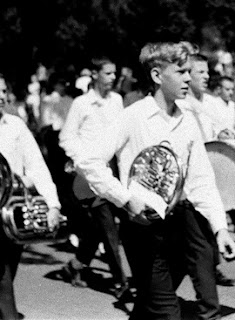
It seems
like forever ago that I spoke with Mark Denekas about Focal Task Specific
Embouchure Dystonia. Talking to him was so important for me because he is
someone I look up to and can relate to as a hornist. First off, here is a bit
of bio about him beforehand. I also posted a clip of his playing with the
Denver Symphony at the end of this blog, it is very moving and inspiring.
Mark
retired in 1997 from the Colorado Symphony after experiencing Embouchure Dystonia
symptoms that gradually heightened. He held the principal horn position longer
than anyone in the orchestra's history:
As
a junior in high school Mark was accepted as a student by Dale Clevenger, the
newly appointed principal horn of the Chicago Symphony. While in high school he performed as
principal horn with the Youth Orchestra of Greater Chicago, winning the soloist
competition in his senior year. He was
subsequently asked to perform on Louis Sudler’s Artist Showcase, on Chicago
Public Television. He was one of the
only high school students selected to play in the Civic Orchestra of Chicago,
the training orchestra of the Chicago Symphony.
Mark attended Carnegie Mellon University where he continued his horn
studies with Forrest Standley. In the
summer following his sophomore year Mark was selected as Principal horn with
the Colorado Philharmonic, now known as the National Repertory Orchestra. There
he gave his first performance of the Second Horn Concerto of Richard Strauss.
The following year he was appointed the principal horn of Chicago’s Grant Park
Symphony, where he performed for the next five summers and was featured as
soloist with Gliere’s Horn Concerto. His
professional status now firmly established, Mark was engaged as an extra and substitute
player with both the Chicago and Pittsburgh Symphony Orchestras. He graduated with honors (Phi Kappa Phi) from
CMU with degrees in Horn Performance and Music Education.
Following
graduation Mark’s career rapidly unfolded with contracts with the New Jersey
Symphony, the Chicago Lyric Opera, the Winnipeg Symphony, and the Pittsburgh
Symphony. During the early years of his
career Mark was privileged to continue his studies with Philip Farkas, the
great former principal horn with the Chicago Symphony. He also studied with the legendary tuba
player Arnold Jacobs, whose knowledge of pulmonary physiology (lung function)
and symphonic and operatic repertoire made him the highly sought after coach of
many professional wind and brass players and vocalists. In September of 1974
Mark became the principal horn with the Denver Symphony which later became the
Colorado Symphony Orchestra. Here he was
one of the most frequently featured soloists. Once established as the leading
horn player in the Rocky Mountain region, he was invited to perform outside of
Colorado as guest principal horn with the Omaha, Columbus, and Honolulu
Symphony Orchestras. At the invitation of Ling Tung, Mark was appointed
principal horn in the prestigious Grand Teton Music Festival.
In
Colorado his teaching career also flourished with students ranging from young
beginners to professionals performing with the Boulder and Colorado Springs
Symphonies and the military bands and orchestras. He was a charter member of the Board of
Directors which founded the Denver Young Artists Orchestra. DYAO quickly became
the outstanding performance opportunity for serious young musicians in
Colorado. As part of the Colorado Symphony Residency programs, Mark gave master
classes and clinics throughout the state. He was a part time lecturer in horn
studies at both CU and UNC. After retiring, Mark has become registered in all
levels of Suzuki Training, and has established one of the leading Suzuki piano
studios in Southeast Denver.
--------------------------------------------------------------------------------------------------------
I
was fortunate enough to contact Mark through a former horn student of his that
is now attending Peabody Conservatory. I spoke to Mark about what I was
experiencing and asked about his experience and advice on Embouchure Dystonia.
One
of the first things we talked about was the importance of relieving the stress
from all the demands that are often placed on us, letting go, and switching to
a different mind-frame than what we've been schooled on. Training, studying,
and performing music requires a much different mind-frame (focused on
technique) and physical approach (focused on mastering difficult repertoire,
breathing, meeting demands and working harder) than that which is required for
rehabilitation. This is our mental hurdle in rehabilitation.
In
rehabilitation, if we are to use any form of analytical thinking, it can't be
used to analyze or criticizing ones skills, techniques, sound, etc. ....it
should be focused on awareness of tension that exists in our embouchure and
fully embracing it, working with it, not against it. Mark stated that you have
to relax your mind first so you can be more attuned to what's going on
physically. This is so true! He said that this state of mind should be
peaceful....you should enjoy playing your horn (even with involuntary muscle
contractions and all). This is the first step: embracing it all, loving it,
enjoying it, a positive attitude/self-esteem no matter how you sound...once you
get past that then you can start focusing on your body/physical recovery .
The next thing Mark spoke about is the importance of learning to separate our
worth from our instrument before we can start physical rehabilitation. This is
our emotional hurdle in rehabilitation. This is similar to the issue that
Denver Dill brings up in his book, learning to completely let go of the ego.
[So much of our success on our instrument starts to define who we are and
becomes too intertwined; this is especially often true the more you excel or
succeed and are rewarded for it - winning competitions, auditions, awards, etc.
We forget why we do what we love, it becomes about depending on external praise
and rewards, trying to keep up with the successful streak, RATHER than focusing
on internal enjoyment and love of what we do - no matter where we do it, or at
what level of playing we are at. Without a doubt such a huge setback forces us
to question and remember why we love our instrument/what we do....it enlightens
us.
It's also similar to my views and how important it is to treat success and
failure as one and the same. All musicians are blessed with "the gift of
music" or "creative calling", it will always remain in us, but
sometimes in life we are taught or forced to see there is more than one way of
sharing it; for example sometimes it comes in the form of teaching/passing on
our knowledge, learning another instrument, another art or endeavor that we
love, becoming passionate about another area of music like music medicine or
injuries, conducting, etc. Sometimes it allows you to focus on other areas of
your life like your health or family, and this in return allows you to see the
bigger picture...whatever that comes to be....believe me, it is better than
what we were striving for before.]
Like
Mark said, it's this huge mental and emotional hurdle we must jump over before
we can put effort into physical rehabilitation. Grieving is a huge process to
get through in time. He goes on to talk about physical rehabilitation with
Embouchure Dystonia, the exercises he does. This is our physical hurdle in
rehabilitation....
First
of all he spoke to me about being aware of tension/symptoms, where it happens,
when, and also the opposite - when it doesn't happen and where. Make it a point
to play your instrument so you can get use to building on this awareness....the
exercises help with spotting areas of tension while helping you learn how to
work your way around. Physical recovery requires working out the tension
through very basic exercises and using your awareness to make slow and subtle
changes in the way you play a specific thing. Sometimes it's not just a change
in your movements, but it can be bigger changes too in your body (ex. how you
hold your instrument, your posture, breathing, etc). But you must be relaxed in
order to do so, in order to understand how things are functioning under the
hood, to become aware of what's happening. [Also I think it helps to have
studied embouchure function at some point (ex. Farkas's 40 virtuosic
Embouchures, Farkas's Art of Brass Playing, etc. Also check out Wilketone's
Embouchure Function blog/videos]. Here are a few exercises, or aspects of
playing that Mark spoke to me about and why he does them:
1.
It's important for him to play on his leg because it allows the mouthpiece to
come to him, rather than him coming to the mouthpiece. It also gives some
stability to hold the horn this way, because playing off of the leg creates
more movement in general due to the arm trying to keep still/trying to hold the
horn stable...this just makes the embouchure even more harder to work with
because it has to additionally focus on trying to adjust to these external
movements. [This is true for me as well! I didn't think about it until now, but
I wonder if working with Pip Eastop's "Pipstick" would help with
external stability/balancing the horn as well? Especially for instruments that
don't have the option of playing on the leg.]
2.
"Always warm up" - getting good blood circulation in the embouchure
is necessary.
3.
"Don't forget to work on breathing." Even if we aren't required of
using a huge expansive breath yet for louder/stronger playing, doesn't mean our
breathing should go neglected or that it isn't important; it is another area of
rebuilding our physical well-being as a musician that needs to be addressed
during recovery, it also is a part of keeping up our physical stamina...and good-feeling
for us in general.
4.
"Don't do long tones as part of rehabilitation because they tend to lock
in faults or cause more irritation/tension in the embouchure." Don't do
them too soon/prematurely, unless you feel you've recovered and can handle
them; remember they are an intense form of training because it involves so much
stamina/endurance. Yes you want to work with your spasms/symptoms, but long
tones are not a good approach because they require so much control over your
embouchure that you haven't regained yet. Recovery requires taking baby-steps
when confronting your symptoms and making slow subtle changes.
5.
"Try to focus on a more relaxed playing if possible" - meaning not
really high, not loud...more of a free flowing feeling; soft, gentle, and slow
in the most comfortable range you can.
6.
Start on a comfortable note like middle F, of the F below that. Do light
tonguing - four groups of 16th notes. Start on a speed that you can do, and
work on slowing it down over time. Doesn't matter if fast or slower...but for
most people it's harder to do slow. This is in most cases for people with embouchure
Dystonia; they can play faster passages, but slow sustained passages are
terribly difficult. So when you practice the four groups of 16ths, for some
reason it doesn't give you embouchure enough time to spasm or jerk, it
distracts the brain from sending the wrong signal. Eventually you will be able
to slow your playing down. [Perhaps this is like a sensory-trick...a way of
tricking the brain? This exercise also reminds me of the slowing-down exercises
that helped classical guitarist Mark Ashford successfully recover from his
Focal Hand Dystonia. How amazing this is to see a similarity in approaches!]
7.
Start on the most comfortable note you can hold. Hold it, then focus working
your way into the note below it. Work on one note at a time...even if you have
to work on the same note day after day. [I do this exercise too, but I start in
my pedal register. It's not that I can't start higher and work my way down to
my middle-to-low ranger, it's that for some reason I feel working in my pedal
range requires less pressure on my lips and doesn't sap my endurance right
away, though it does require a lot deeper air, and it relaxes my face more
while giving good blood circulation, though it's also not the easiest register
to improve upon.] He also said that Max Schlossberg's Daily Trumpet Drills have
helped him out a lot.
8.
Mark said that an excerpt that is usually very difficult for horn players with
Embouchure Dystonia to play is Mussorgsky's Pictures at an Exhibition; it
reveals most symptoms associated with Embouchure Dystonia because it's in the
middle-to-low register, it is moderate to slow tempo, slurred, has some wide
intervals and lyrical....this is an excerpt that is usually very easy for horn
players as it covers our most basic abilities - what would normally be
comfortable. Therefore it is a good reference to see how you are doing every
now and then by trying to play it. Also if you do think you have Embouchure
Dystonia, this might be something you should test to see if you can play
through or not, because for most it is such a grueling challenge to get
through.
9.
Practice in a room that is large and sounds good, it will boost your
confidence/liking of your own sound. It's much better than being in a small
muffled sounding room. Also it helps you face your fears...most people are
afraid of being heard by someone because the way they are physically struggling
and how it comes to sound. [I totally agree...however, if not comfortable
playing in a larger room yet, start by practicing somewhere public like a
University practice room, then work your way to practicing in a larger
classroom, then to a stage; but always imagine someone is listening, and remind
yourself positive thoughts - that you accept and love your sound, flaws and
all, that you are doing your best and that no one has a right to judge you,
that you are doing this for yourself, for your love and passion, even for a
higher being if that is what it takes! Also for me, I found by teaching my
6th-8th grade brass playing students it helped me cope with things as well
because I had to play with them and for them...it was also humbling because we
played around the same level, yet they never judged me and thought I was the
best sounding horn player ever! It was so therapeutic to feel I was doing
something with what I love...even if I barely could play at the time.]
The
last thing Mark and I talked about was botox treatments with brass musicians
who have Embouchure Dystonia. Studies show it doesn't help a majority of brass
players with Embouchure Dystonia (it has shown improvement in Hand Dystonia
though), but he said there are some brass musician's he knows who do receive
botox injections and have had success with it. But Mark also warned about being
cautious of botox because it is still a risk even in small doses, and that it
is one of those things a person would come to rely on completely... they would
depend on it, and he can only imagine it must be like a roller coaster ride
where one probably feels relieved of their disorder temporarily until the botox
starts to wear off. It is perhaps better off without it. He also said if you
are young, take care of yourself, and remember that the body/brain can adapt,
it may be possibly heal itself in time. He also mentioned that he believes what
lead to his Embouchure Dystonia was overuse. He was diagnosed by Dr. Steven
Frucht; Dr. Frucht and horn player Glen Estrin founded Musician's With Dystonia
at the Dystonia Medical Research Foundation (DMRF).
Mark's
conversation meant a lot to me, coming from a former professional horn player
of one of my favorite orchestras! (I am also a past Colorado/UNC horn student).
His legend lives on, and I know that when I hear recordings of his playing with
the former Denver/Colorado Symphony Orchestra, his personality shines
through...and that remains with him always. Here is a recording of him! Absolutely outstanding tone and musicality!
Ravel – Pavan for a Dead Princess. Denver Symphony Orchestra; Philippe Entremont; Mark Denekas, horn solo.